
Most owners can’t tell me what’s actually broken about how their business shows up online. That’s not a knock — it’s the whole problem. You can’t fix what you can’t see, and you can’t see your own listings, your own site, or your own inbox the way a stranger does. A good online presence audit is someone doing exactly that: looking at your business the way a customer would, then handing you a short list of what to fix first. Here’s what a real one looks at, what mine costs (nothing), and why I won’t turn it into a sales call.
You can’t see your own presence the way a customer does
You know your hours. You know your address. You know the phone number. So when a customer pulls up your business on their phone, you assume they see what you see.
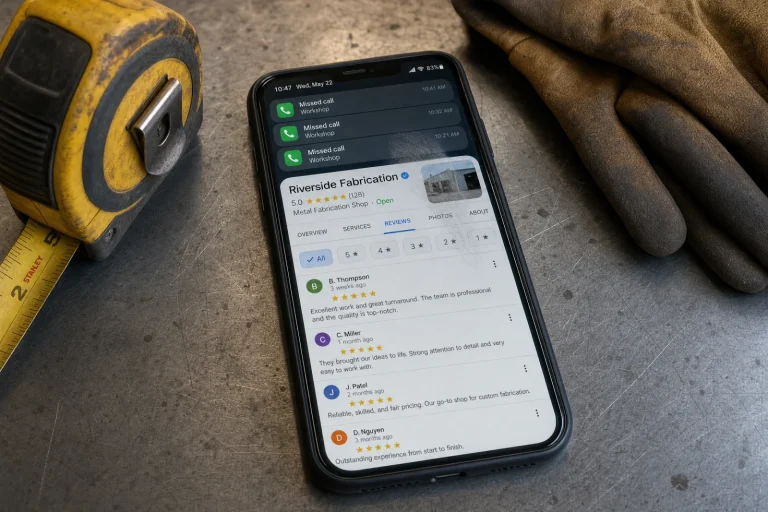
They often don’t. A recent Data Axle survey of 1,000 U.S. consumers (February 2026) found that 66% of people have visited or tried to visit a business only to find its online information was wrong — the old address, last year’s hours, a number that rings nowhere. And it sticks: 85% said incorrect or outdated information affects whether they’ll choose that business again, with 37% saying it weighs heavily.
That’s the part owners miss. The wrong hours on a directory you forgot you were listed on. The contact form that quietly errors out on an iPhone. The five-star review from March that nobody ever replied to. None of it shows up when you look, because you already know the right answer. An audit is a fresh set of eyes running the same path a customer runs — search, profile, site, contact — and writing down everywhere reality and the listing disagree.

How a presence drifts out of date
Nobody breaks their online presence on purpose. It drifts. You changed your hours for the season and updated Google but not the three other places you’re listed. You moved, and a directory you’ve never logged into is still showing the old address it scraped years ago. A staff member who used to answer reviews left, and the replies stopped. Your site was fine in 2022, and the world quietly moved to checking everything on a phone.
Every one of those is small. Stacked together, they’re the gap between how put-together you actually are and how put-together a stranger thinks you are at 8PM on a Tuesday when they’re deciding who to call. An audit’s whole job is to find that gap before it costs you the next month of work — not to make you feel behind.

The expensive part is guessing
Here’s the pattern I see most. An owner feels like something’s off — the phone’s quieter than it should be — so they buy a fix. A new website. An ads budget. An “SEO package” from whoever called that week. They spend first and diagnose never.
Sometimes the new site wasn’t the problem. The problem was three wrong listings, a Google profile that was half-filled, and an inbox nobody was watching. You can pour money into a beautiful new site and still lose the same customers, because the leak was upstream of the thing you replaced.
Diagnose first, then spend. A thirty-minute look at the whole picture tells you where the money should actually go — and as often as not, where it shouldn’t.
What a real online presence audit looks at
When I run one, I’m not grading your taste in fonts. I’m walking the path a customer walks and checking the handful of places a small business quietly loses work:
- Can people find you at all? Mostly this is your Google Business Profile — the thing that shows up in the map and the “near me” results. Google’s own numbers say customers are 70% more likely to visit, 50% more likely to consider buying, and 2.7× more likely to see you as reputable when that profile is complete versus half-filled. “Complete” beats “exists.” Here’s the full walk-through of getting it right.
- Is what they find correct, everywhere? Not only on your site — on Google, on the directories, on the old listing from two locations ago. In that same survey, 87% of people said they’re more likely to choose a business with accurate, complete information, and 90% said it matters that the info is right wherever they run into it. Consistency is a ranking signal and a trust signal at the same time.
- Does your site do its one job on a phone? Loads fast, says what you do, makes the next step obvious. Most of your visitors are on a phone; the site has to work there first. More on what a site actually needs to do.
- What happens the moment someone reaches out? A form that works is half of it. The other half is whether anyone answers quickly — that’s usually where booked jobs are won or lost. How to turn a visitor into a booked job.
- Is there proof at the point of decision? Recent reviews, replies to them, a profile that looks alive rather than abandoned in 2021.
- Can you tell where your leads come from? If you can’t name your best source, you can’t double down on it. An audit flags whether you’re even measuring.
None of those are exotic. That’s the point — they’re ordinary things that fall out of date while you’re busy doing the actual work.
What you get from me — and what you don’t
This is where a free audit usually turns into a trap: someone “audits” you, then the report is a forty-page PDF engineered to make you panic and buy the biggest package. I don’t do that, and it’s the main reason I keep this offer around.
What you get is a short, prioritized, plain-English list — the few things to fix first, in order, with one line on why each one matters. Picture three or four lines like: claim and complete your Google profile, it’s half-filled; fix the hours on two old listings; the contact form fails on mobile — here’s the fix. That’s it. If the top item is something you can knock out yourself in an afternoon, I’ll tell you that and tell you how. No jargon, no obligation, no contract, no follow-up sales call you have to dodge. I’d rather you fix three things and remember that I’m the one who told you straight than sign you up for work you didn’t need.
If some of it is worth handing off, I’ll say so and we can talk. But the audit is a diagnosis, not a pitch — the value is the clarity, whether or not you ever hire me.
How to get yours
Start with the 60-second Automation Scorecard. It’s the fast version of the audit you can run yourself right now — a handful of questions that surface your single biggest leak on the spot, no call required. Most owners are a little surprised by what comes back.
From there, the full online presence audit is the natural next step: I take your specific answers, look at your actual profile, site, and listings the way a customer would, and send back that prioritized fix list. Same calm, no-pressure read — only on your real business instead of a quiz.

You don’t need to know what’s wrong before you start. That’s the whole point of looking.