We burned through eight thousand dollars a month for four months on AI search engine optimization tools before we figured out we were chasing the wrong thing. It started last spring when a plumbing client called asking why their site had dropped from the middle of page one to page two for their best keyword. We panicked and signed up for an AI content optimizer that promised to analyze top-ranking pages and rewrite ours to match. The tool rewrote the entire service page in three minutes, added a dozen new headers, stuffed in keywords we had never used, and made the whole thing read like a robot wrote it. We published it anyway because the tool said it would rank.
Two weeks later the page dropped to page three.
So we tried a different tool, one that claimed it could automate internal linking and keyword clustering across the whole site. It ran for six hours, created two hundred new internal links, and reorganized our service pages into clusters that made no sense. An HVAC page was linking to a plumbing page because they both mentioned water heaters. We rolled it back after a week when the client said their phone stopped ringing.
The third tool was supposed to track when our clients appeared in AI search results from ChatGPT and Perplexity. We paid for it for two months and got a dashboard full of charts showing how often our brand was mentioned in AI answers. The problem was none of those mentions turned into phone calls or form fills.
What actually moved the needle was simpler. We pulled up Google Search Console, found three service pages ranking on page two for high-intent keywords, and rewrote them by hand. We added real project details, cut the fluff, put the phone number higher, and made the page load faster. Two of the three pages hit the top five within a month. The client started getting calls again. We canceled six of the eight AI tools we were paying for and kept two that actually helped us do that work faster.
The Two AI Search Engine Optimization Tools We Actually Keep Paying For
We still pay for Semrush and Clearscope, and we would cancel everything else before we canceled those two. Semrush went up to $229 a month in January, which annoyed us, but their AI Content Assistant finds keyword gaps we miss when we are staring at a service page for the tenth time. We used it last month to rebuild an electrical contractor’s emergency repair page. The tool pulled up twenty related keywords we had not thought to include, half of them local phrases people actually search when their power goes out at midnight. The page went from position twelve to position four in three weeks.
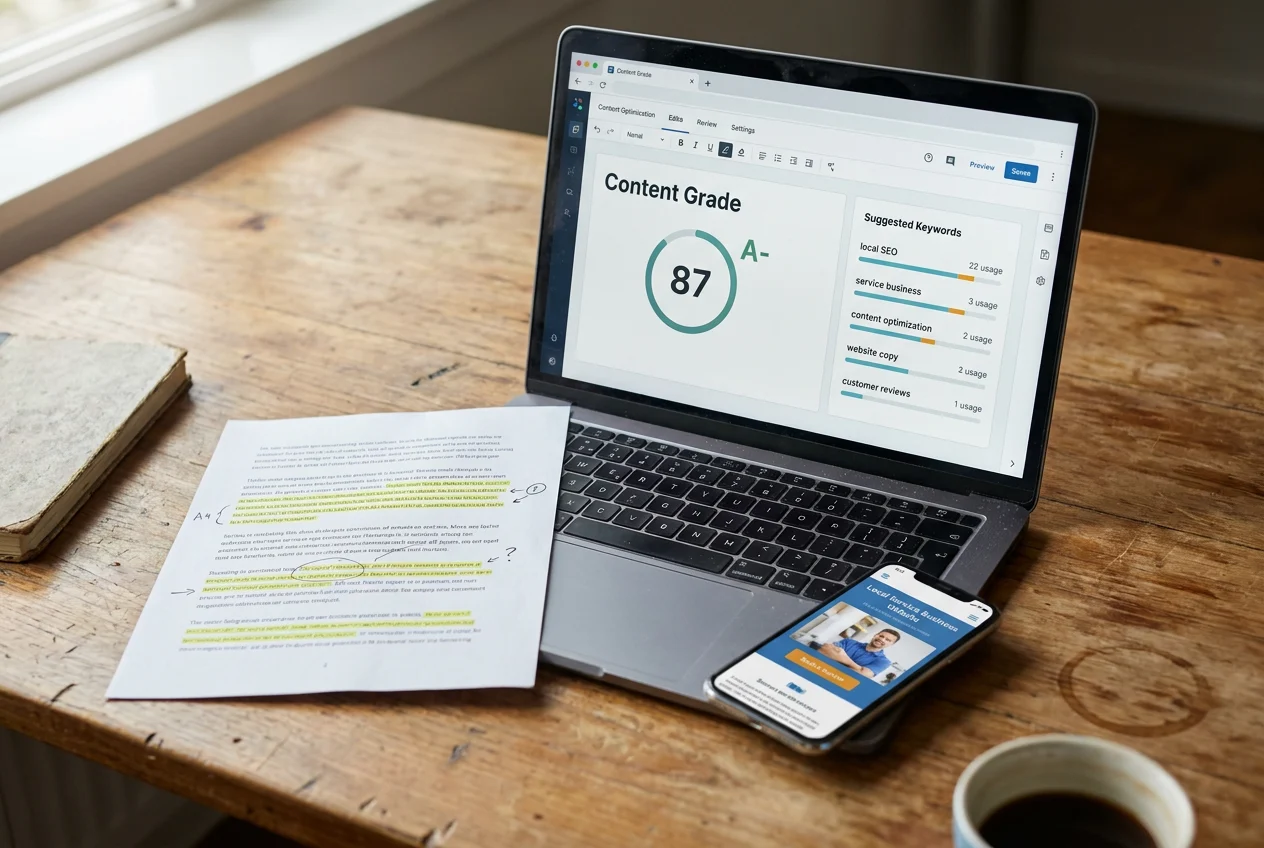
Clearscope costs $189 a month and grades content on an A-F scale, which sounds gimmicky until you use it to compare your page to the top five results and realize you are missing entire sections your competitors cover. We used it to fix a landscaping page that was stuck on page two. The tool flagged that every top-ranking page mentioned seasonal timing and our page did not. We added two paragraphs about when to schedule the work and the page moved up six spots.
Everything else we tried either automated tasks that should not be automated or tracked metrics that do not turn into jobs. AI internal linking tools create nonsense connections. AI content generators write pages that sound like everyone else’s pages. AI rank trackers for ChatGPT and Perplexity are interesting but useless if your clients need phone calls, not brand mentions in an AI chat window.
Why Your AI Tool Will Confidently Destroy Your Rankings If You Don’t Do This One Thing First
Every AI content tool will rewrite your page with total confidence and zero understanding of what makes your business different from the one two towns over. We watched this happen to a roofing contractor last summer. They used an AI tool to improve their storm damage page, and the tool rewrote it to match the top-ranking pages in the country. It added sections about insurance claims, emergency tarping, and inspection checklists. All of it was generic advice pulled from high-authority sites. None of it mentioned the contractor’s twenty-four-hour response time or the fact that they work directly with three local insurance adjusters who trust them.

The page dropped from position six to position fourteen in two weeks because it stopped sounding like a real business and started sounding like a blog. The fix was simple but not automated. We pulled the AI-generated content, kept two of the new headers, and rewrote the rest with details only that contractor could provide. Real project photos, real timelines, real names of the insurance companies they work with. The page climbed back to position five.
The one thing you have to do before you let an AI tool touch your content is mark the sentences that only your business can write. If a competitor could copy and paste a paragraph onto their site without changing a word, that paragraph is not helping you rank. These AI search engine optimization tools do not know what makes you different. You have to protect that information before you let the tool improve anything else.
How We Test Whether an AI Tool Is Actually Making Us Money or Making Us Busy
We started tracking this the hard way after we realized we were paying for tools that made us feel productive without actually bringing in more jobs. Last fall we ran a test with an HVAC client who wanted to rank for furnace repair in three nearby towns. We used an AI keyword research tool to find twenty long-tail keywords, then wrote ten pages by hand and ten pages with AI assistance. All twenty pages went live the same week. We tagged them in Google Analytics so we could see which ones brought in form fills and phone calls.

After sixty days the hand-written pages had generated fourteen phone calls and six form submissions. The AI-assisted pages had generated three calls and one form fill. The difference was not the keywords or the page structure. It was the details. The hand-written pages mentioned specific neighborhoods, specific furnace brands the company works on, and specific problems they see in older homes in that area.
Now we test every tool the same way. We pick one task, run it with the tool and without the tool, and measure the outcome that matters. For a content optimizer, the outcome is not a higher content grade. It is whether the page moves up in rankings and whether it brings in calls. For a keyword tool, the outcome is not how many keywords it finds. It is whether those keywords turn into pages that rank and convert. If we cannot draw a straight line from the tool to more qualified leads, we cancel it.
The SEO Work AI Still Can’t Touch (And Why Pretending It Can Will Cost You Clients)
AI tools can pull keyword data and rewrite meta descriptions faster than we can, but they cannot figure out why a competitor’s page ranks when it should not. We ran into this last month with an electrician who was losing to a competitor’s page that had half the content, no reviews, and a site that looked like it was built in 2015. The AI tools we ran all said our client’s page was better optimized. Higher word count, better keyword density, faster load time, more backlinks. But the competitor was in position three and our client was in position nine.
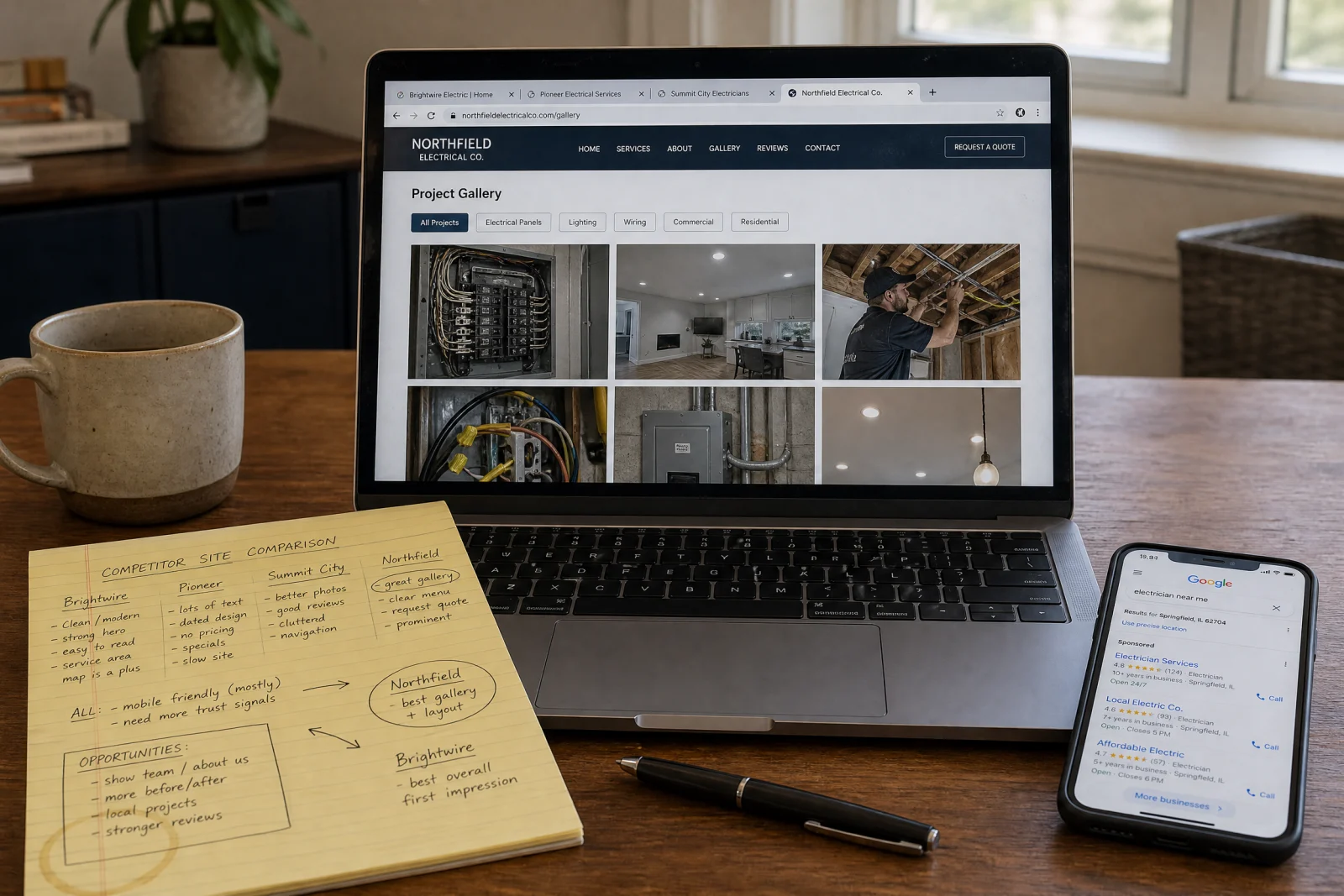
We had to dig through the competitor’s site by hand to figure it out. Turns out they had twenty pages of project photos tagged with the exact neighborhoods they served, and every photo had alt text that mentioned the street name and the type of work. Google was treating them as the local authority because they had proof they worked in those areas. No AI tool flagged that because no AI tool knows to look for geographic proof in image metadata. We rebuilt our client’s photo gallery with the same structure and they moved up to position five in six weeks.
AI also cannot write the one paragraph on a service page that actually convinces someone to call. We have tested this a dozen times. The AI writes a paragraph that sounds professional and covers the topic, but it does not answer the question a homeowner is really asking, which is usually some version of “Can I trust you to show up and not rip me off?” That paragraph has to come from a real person who knows what objections come up on sales calls.
The same goes for local keyword research. You learn that by reading your call logs and listening to how real people describe the problem when they call.
The 13 AI Search Engine Optimization Tools Worth Testing in 2026
We keep coming back to Semrush even after they raised the price to $229 a month because their AI Content Assistant finds keyword gaps we miss and their keyword tracking still works better than anything else we have tried. Clearscope at $189 a month is the only content grading tool we trust because it compares your page to the actual top ten results instead of some generic content database. Those two tools do different jobs and we use both of them every week.
Ahrefs raised their AI content features to $399 a month, which is too expensive unless you are running SEO for a dozen clients, but their backlink data is still the most accurate we have found and their AI Content Helper at $129 a month writes better meta descriptions than we do. SE Ranking starts at $95 a month and includes rank tracking across Google AI Overviews, which matters if you are trying to figure out whether AI search results are eating your traffic.
For tracking whether your brand shows up in ChatGPT or Perplexity, Rankscale.ai starts at $20 with no subscription and tracks mentions across AI search engines by keyword and region. We used it to see if a plumbing client was getting mentioned in AI answers for emergency keywords. They were not, which told us we needed to add more FAQ content to the site. Writesonic starts at $16 a month if you pay annually and writes decent first drafts for blog posts, but you have to rewrite them with real details before you publish.
AirOps offers a free plan with enough tasks to test it, and their $199 a month Pro plan automates research if you are building a lot of content at once. We used it to pull competitor data for a landscaping client who wanted to add ten new service pages in one month. It saved us a few hours of manual work but it did not write anything we could publish without heavy editing. For generative engine optimization specifically, tools like Profound, Anvil, and Athena track when your site appears in AI Overviews, but we have not found a use case where that data changes what we do.
The tools we canceled and will not go back to are the ones that automate internal linking, rewrite entire sites in one click, or promise to generate hundreds of pages of content without human input. They all create work that looks fine in a dashboard and terrible to a human reader. We also stopped paying for tools that track social signals, brand mentions on forums, or sentiment analysis.
Audit Your Current Stack This Week—Here’s Exactly What to Cut
Pull up your subscriptions right now and look at every tool you paid for in the last three months. If you cannot name one specific page that ranks higher or one specific lead that came in because of that tool, cancel it. We did this in December and cut our tool budget from $8K a month to $2K a month without losing a single ranking or lead. The money we saved went into faster hosting, better photography, and paying a writer to add real project details to service pages.
If you are paying for an AI content generator that writes full pages, cancel it unless you are rewriting every page by hand before you publish. If you are paying for an AI internal linking tool, cancel it and build your internal links manually based on what makes sense to a reader. If you are paying to track your brand mentions in ChatGPT or Perplexity but you have not seen a single lead come from AI search, cancel it and spend that money on a tool that tracks what actually matters.
The test is simple when evaluating your AI search engine optimization tools. Every tool should either help you rank higher for keywords that bring in jobs, or help you convert more of the traffic you already have. If it does neither, you are paying to feel busy instead of paying to grow. That electrician who lost to the competitor with the terrible site finally moved up after we stopped improving content scores and started adding proof he actually works in those neighborhoods. That plumber who dropped to page three got back to page one after we stopped letting AI rewrite his pages and started writing them with details only he could provide. The AI search engine optimization tools we kept are the ones that helped us do that work faster. If you are not sure where your own site stands or which changes would have the biggest impact, our free scorecard walks through the same checks we use with clients. Everything else was noise.