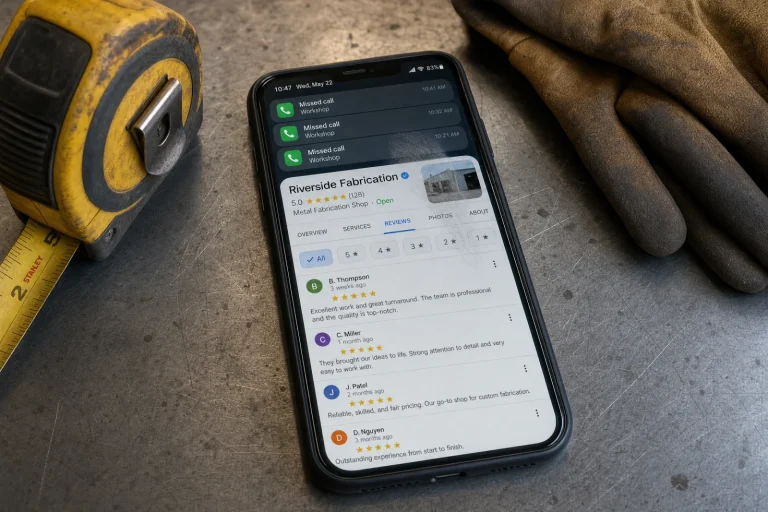
Small business branding tips help business owners diagnose branding problems before making the wrong next move.
A landscaping company called us last spring after losing a job they thought was locked in. The customer had visited their website, liked what they saw, and then checked their Facebook page before calling. The website showed a polished crew in matching shirts with a tagline about reliability. The Facebook page had not been updated in eight months, the profile photo was blurry, and the last post was an unanswered customer complaint.
The customer called the competitor instead.
We hear versions of this story more than we should. A business spends money on a nice website, then forgets that people check everywhere before they decide to trust you. When your Google Business Profile says one thing, your website says another, and your social media looks abandoned, people notice. They move on to someone who looks like they have it together. These small business branding tips address exactly that problem.
Consistency is not about being perfect everywhere. It is about making sure that when someone sees your business in three different places, they recognize it as the same business. That means the same logo, the same colors, the same tone of voice, and the same level of care. A plumbing company we worked with had a professional website, but their Google listing had an outdated phone number and three-year-old photos. The competitor down the street had newer photos, faster responses, and everything matched.
We rebuilt that plumber’s presence by starting with one decision: pick a color palette and stick to it. Dark blue and orange. Every photo, every post, every page. Then we made sure the phone number on the website matched the number on Google, Facebook, and the truck wrap. We updated the Google photos every two months. Within six weeks, they started getting calls from people who said they looked more established than the other guys.
The landscaper did something similar. They hired someone to post on Facebook twice a week—finished jobs and seasonal tips. They updated their profile photo to match the website logo. They made sure every platform had the same tagline and phone number. Three months later, they landed a commercial contract because the property manager said their online presence looked consistent and professional.
The Visibility Problem: Being Findable Isn’t Optional
Great work that nobody can find does not exist in the mind of a customer who needs help right now.
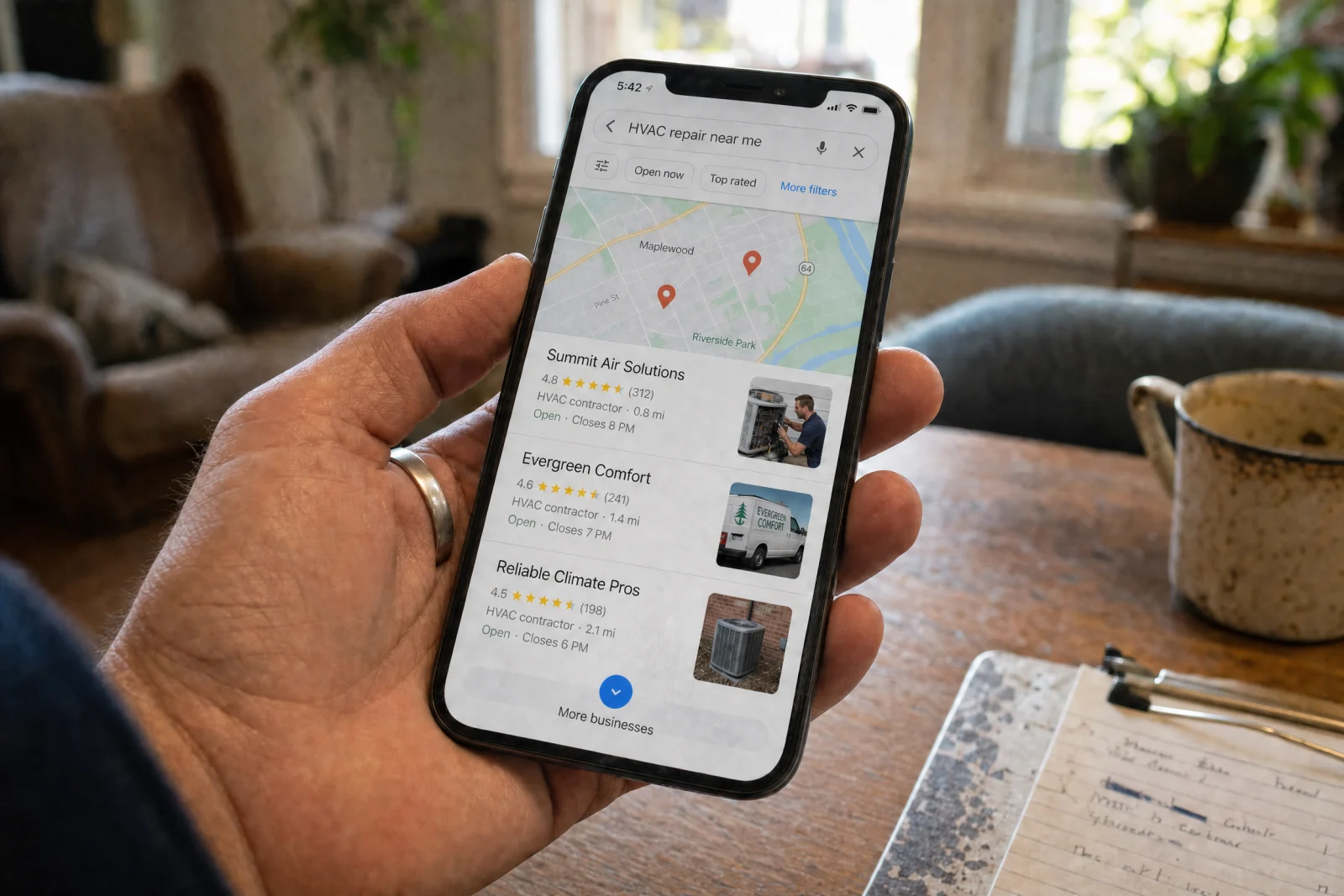
When someone’s air conditioner dies at 8pm on a Saturday in July, they are not asking neighbors for recommendations. They are pulling out their phone and searching. If you are not in the top three results on Google Maps, you are invisible. If your Google Business Profile has no recent reviews or the hours say you are closed, they are calling someone else.
An HVAC company we worked with in 2025 had been in business for twelve years. They did excellent work. But their Google listing had four reviews from 2022 and no photos. A newer competitor had thirty-eight reviews and updated photos every month. Guess who got the Saturday night emergency calls.
We fixed their Google Business Profile first. Added current photos of the team and trucks. Started asking every happy customer for a review with a simple text message the day after the job. Within four months, they had fifty-three reviews and started showing up in the top three for local searches. The owner got three emergency calls in one weekend, all from people who said they picked him because he looked busy and reliable.
Why Your Brand Voice Matters More Than Your Logo
A cleaning company reached out to us in early 2025 because their website was getting traffic but almost no one was filling out the contact form. We looked at the site and it was fine. Clean design, good photos, clear services. But the copy sounded like it had been written by a committee of lawyers.
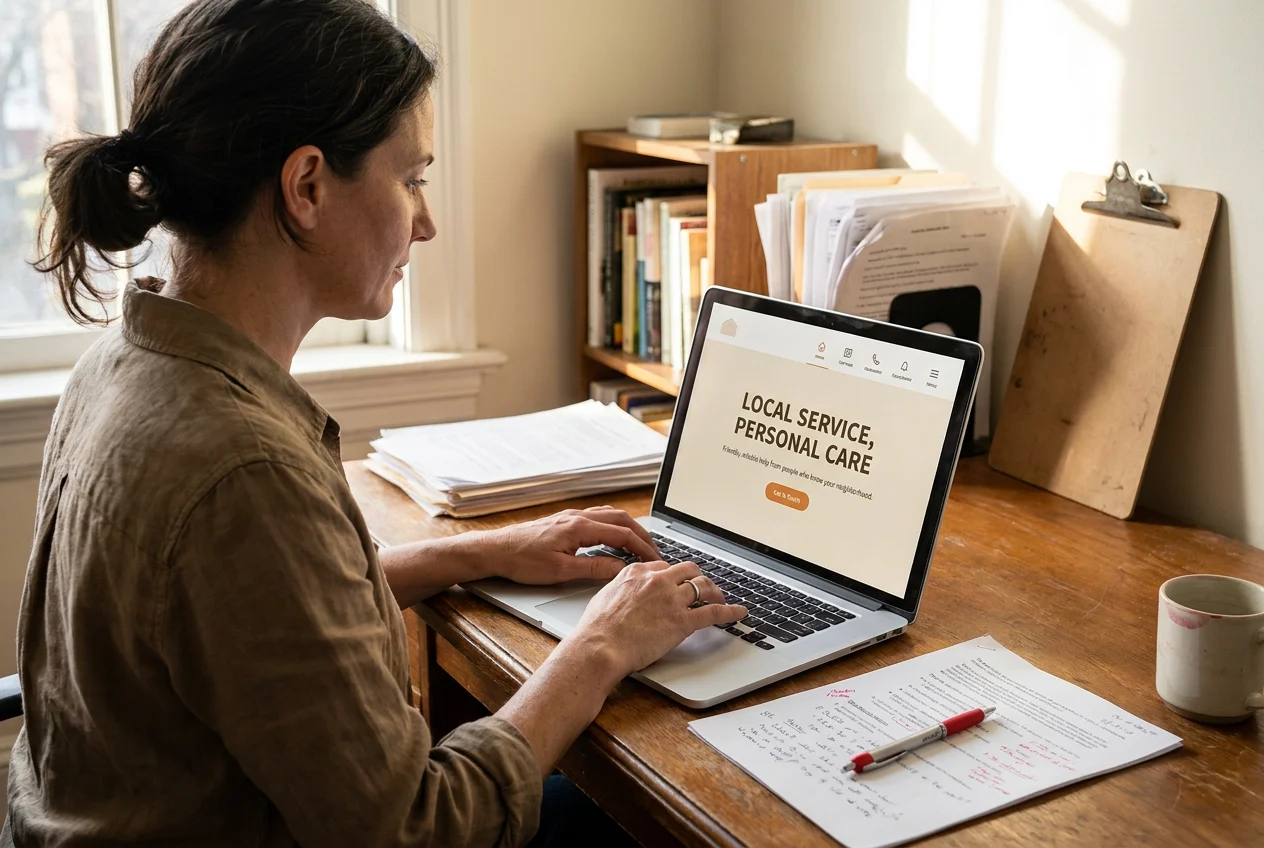
We rewrote the homepage in the voice the owner actually used when she talked to customers. Friendly, direct, a little bit funny. Instead of “Our team is fully trained and insured,” we wrote “Our crew shows up on time, does not skip corners, and you can trust them in your home.”
The form submissions doubled in three weeks.
People do not hire a service business because the logo is pretty. They hire because something about the way you talk makes them feel like you get it. A roofer who says “We know you are stressed about this, so we will walk you through every step” sounds different than a roofer who says “We offer complete roofing solutions.” One sounds like a person. The other sounds like a brochure.
Social Proof Without the Desperation
Asking for reviews is fine. Begging for them makes you look desperate.
The businesses that get the most value out of reviews are the ones that make it easy and put the proof where decisions actually happen. For most local service businesses, that place is Google. Not your website testimonials page that nobody visits. Google, because that is where people are comparing you to your competitors in real time.
An electrician we worked with had a dozen great reviews buried on his website and almost nothing on Google. We moved the ask. Every time he finished a job and the customer was happy, he sent a text with a direct link to leave a Google review. No long email. No multi-step process. “Hey, if you have a minute, we would love a review” and a link. He went from six Google reviews to forty-one in five months, and his call volume went up enough that he hired another technician.
The other thing that works is showing proof at the moment of doubt. A plumber added a small badge to his contact page that said “127 five-star reviews on Google” with a link. Conversion on that page went up because people could verify the claim in two seconds.
Small Business Branding Tips: The DIY vs. Professional Decision
We rebuilt our own brand in 2023, and we had to make the same call every small business makes: what do we do ourselves, and what do we pay someone else to do?
We DIY’d the brand voice and messaging because nobody knows how we talk to clients better than we do. We wrote our own website copy, email templates, and social posts. That saved us thousands of dollars and made sure everything sounded like us.
We hired a designer for the logo and color palette because we are not designers. That cost us about $1,200 and gave us a visual identity we could actually use everywhere without cringing. The designer also built us a one-page brand guide with the logo files, exact color codes, and fonts. That guide has saved us hours of decision-making every time we need to make something new.
The rule we follow with clients is this: if it is your expertise, do it yourself. If it is not, and it is something customers will see and judge you on, hire it out. A landscaper should not be designing their own logo. But they absolutely should be writing their own service descriptions because they know what customers actually care about.
What Customers Actually Notice When They Decide to Trust You
We have watched hundreds of service businesses try to figure out what makes someone pick up the phone and call. And the answer is almost never what the business owner thinks it is.

It is not the tagline. It is not the mission statement. What people notice is whether you look like you are still in business, whether other people have hired you and been happy, and whether you make it easy to reach you.
A painting contractor we worked with had a beautiful website and almost no calls. We looked at his Google Business Profile and it said his hours were Monday through Friday, 9 to 5. Most people searching for a painter are doing it at night or on the weekend when they are home and thinking about it. They saw those hours and assumed he was not available. We changed it to “By appointment, call anytime” and added his cell number. Calls went up the same week.
Another business, a carpet cleaning company, had great reviews but they were all from 2023. It was now 2026. People scrolling through saw that gap and wondered if the business was still operating or if quality had dropped. We helped them start asking for reviews again, and within two months they had fresh proof that they were still doing good work.
People also notice speed. We worked with a plumber who let a Friday afternoon form submission sit until Monday morning. By then, the customer had already hired someone else who called back in twenty minutes.
Why Half of Small Businesses Fail (And How Branding Plays a Role)
Nearly half of all startups fail within the first five years, according to the U.S. Bureau of Labor Statistics. A big chunk of that is because there was no real demand. But another 22 percent fail because they did not have the right marketing strategy.
What does that have to do with branding? Everything.
A service business with inconsistent branding, no clear message, and no strategy for showing up where customers are looking is a business that is invisible. And invisible businesses do not get customers. A great electrician who does excellent work but has a website that looks like 2011, no Google reviews, and a Facebook page that has not been touched in a year is failing because of marketing, not because of skill.
The businesses that survive are the ones that figure out how to show up, stay consistent, and make it easy for people to trust them. That is not expensive. It does not require a rebrand every year. It requires showing up in the same way, in the same places, with the same message, until people start to recognize you.
The One Thing Every Small Business Gets Wrong About Branding
Most small business owners think branding is something you do once. You pick a logo, you build a website, you are done.
That is not branding. That is design.
Branding is what you do every single day. It is how you answer the phone. It is whether you show up on time. It is whether your truck is clean. It is whether you follow up after the job. It is whether your Google photos are from this year or three years ago. It is whether the tone of your website matches the tone of your voicemail greeting.
We worked with a landscaping company that had a gorgeous website and a terrible reputation for not calling people back. The website promised reliability and responsiveness. The reality was that half the leads sat in their inbox for two days before anyone looked at them. That gap between the brand promise and the actual experience is what kills trust faster than anything else.
We helped them set up a system where every form submission sent a text to the owner immediately, and he committed to calling back within an hour. That one change turned their brand from a lie into the truth. The website said they were responsive, and now they actually were. Conversion went up because the experience finally matched the promise. If you are not sure how your own follow-up process stacks up, our lead capture system walks through the same approach we use with service businesses.
How Much You Should Actually Spend on Branding in 2026
We get asked this constantly. And the answer depends on where you are.
If you are starting out and testing whether your business idea even works, spend less than $1,000. Get a template logo from a site like Canva or hire someone on Upwork to make you something clean and simple. Spend the rest of your money on showing up where customers are and proving that people will actually hire you.
If you have been in business for a year or two and you are starting to get steady work, spend $5,000 to $20,000 on a real brand identity. That gets you a professional logo, a color system, a brand guide, and usually a website refresh. This is the stage where looking credible starts to matter because you are competing with established businesses.
If you are scaling or preparing to expand into new markets, you might spend $50,000 or more on a full rebrand with strategy, messaging, photography, and campaign concepts. But that is rare for most local service businesses. A plumber in Tampa does not need a $50,000 brand. They need a $10,000 brand that looks professional and shows up consistently.
The rule we follow is this: spend about 10 percent of your marketing budget on branding. If you are spending $3,000 a month on ads and lead generation, put $300 a month toward keeping your brand fresh—new photos, updated posts, review requests, website tweaks.
The Brands That Built Trust by Giving Away Knowledge
Some of the most trusted brands in the world built that trust by teaching people things for free. Companies like HubSpot and Ahrefs became household names in their industries not because they had the best product, but because they gave away so much useful information that people started seeing them as the authority.
Local service businesses can do the same thing on a smaller scale. A plumber who posts a two-minute video every week showing homeowners how to fix a leaky faucet or unclog a drain is building trust. People watch those videos, try the fix, and when it does not work or they need something bigger, they call the plumber who taught them. They already trust him because he helped them for free.
We worked with an electrician who started writing short blog posts about common electrical problems and when to call a professional versus when to DIY it. His website traffic went up, but more importantly, the people who called him were better leads. They had already read his stuff. They trusted his advice. They were not shopping around for the cheapest bid.
What Happens When Your Actions Don’t Match Your Brand
Patagonia donates profits to environmental causes. Ben & Jerry’s has been loud about social justice for decades. These brands are trusted not because they say they care, but because they put money and action behind it.
For a local service business, the version of this is simpler but as important. If your website says you are available 24/7, your phone better be answered 24/7. If your tagline is about quality, you better not be cutting corners to finish jobs faster. If you promise same-day service, you better show up the same day.
We worked with an HVAC company whose website said “We treat your home like our own.” Great line. But they had a habit of leaving job sites messy—tools in the yard, packaging in the driveway, dust on the floor. Customers noticed. Reviews mentioned it. The brand promise and the actual experience were miles apart.
We helped them build a simple end-of-job checklist: sweep the area, pick up all trash, wipe down the equipment, walk the customer through what was done. It took five extra minutes per job. Within two months, reviews started mentioning how clean and professional they were. The brand finally matched the experience, and people trusted them more because of it.
The Fastest Way to Lose Trust (And How to Avoid It)
The fastest way to lose trust is to be inconsistent in a way that makes people question whether you are still paying attention.
We have seen businesses lose jobs because their Google Business Profile said they were open and they were actually closed. We have seen businesses lose credibility because their last Facebook post was from 2023 and it was a customer complaint that never got a response. We have seen businesses lose leads because the phone number on their website was different from the number on their truck.
These are not big branding failures. They are small cracks that add up. And when someone is deciding whether to trust you with a $3,000 HVAC repair or a $10,000 landscaping project, those cracks matter.
The fix is not complicated. Every quarter, do a brand audit. Visit your own website like you are a customer. Google your business name and see what comes up. Check your Google Business Profile, your Facebook page, your Instagram. Make sure everything is current, everything matches, and nothing looks abandoned.
One of our clients does this the first Monday of every quarter. Takes them twenty minutes. They have caught outdated hours, broken links, old photos, and missing phone numbers before customers ever saw them.
Audit Your Brand Right Now (Before Your Competitor Does)
Here is what you should do today, before you finish reading this. Pull out your phone. Google your business name. Look at what comes up. Click on your Google Business Profile. Check your website. Open your Facebook page. Look at your Instagram if you have one.
Write down three words that describe what you see. If those words do not match the brand you think you have, you have work to do.
Now do the same thing for your closest competitor. Google them. Look at their profiles. Compare what you see to what you saw when you looked at your own business. If they look more current, more consistent, or more trustworthy, that is why they are getting calls you are not.
These small business branding tips are not theory. They are what we have watched work for hundreds of service businesses over the last eight years. The ones that show up consistently, make it easy to trust them, and back up their promises with action are the ones that survive and grow. The ones that treat branding like a one-time project are the ones that wonder why nobody is calling.
Your small business branding tips checklist starts with consistency across every platform, continues with making yourself findable where customers are searching, and ends with making sure your actions match your promises. When you set up these small business branding tips today, you position yourself ahead of competitors who are still treating their brand as an afterthought. If you want help identifying where your online presence might be costing you calls, our free scorecard walks through the same checks we use. Your next customer is already searching.