How to get more google reviews is the problem this guide helps a business owner diagnose before making the wrong next move.
A landscaping company we worked with last summer had been in business for eleven years. They did great work, had steady clients, and their Google Business Profile sat at 4.3 stars with fourteen reviews. Fourteen. In eleven years. When we asked the owner why he never asked for reviews, he said he figured customers would leave one if they wanted to. Three months later, after setting up a simple system for how to get more Google reviews, he had sixty-two reviews and a 4.8-star average. His map ranking jumped from page two to the top three in his area, and he booked nine jobs in one week that he traced directly to people finding him on Google Maps.
The problem was never that his customers did not want to leave reviews.
The problem was that he never gave them permission to do it. Most service business owners assume asking for reviews feels pushy or desperate, so they stay quiet and hope customers will think of it on their own. But customers are not thinking about your Google ranking when they walk back inside after you finish the job. They are thinking about dinner, or their next meeting, or whether the AC is finally cold enough. Leaving a review does not cross their mind unless you bring it up, and when you do not, they assume you do not need it. That silence costs you jobs every single week, because the competitor with ninety reviews and 4.8 stars is getting the call instead of you.
We have been building websites and lead systems for HVAC, plumbing, electrical, and other service businesses since 2018, and we have watched this play out over and over. The businesses that rank well in local search in 2026 are sitting at 4.8 stars or higher. Most small service companies are stuck between 4.2 and 4.6, which used to be fine but is not anymore. Google is using reviews to train its AI responses and local search algorithms, so the words customers use in reviews now affect whether you show up when someone searches for what you do. A business with fewer than ten reviews struggles to compete no matter how good the rest of the SEO work is. Crossing ten reviews, then fifty, then a hundred makes you look established. A company with five hundred reviews can absorb a one-star hit without flinching. A company with twenty cannot.
The gap between fourteen reviews and sixty-two reviews is not luck. It is a system. And it starts with understanding how to get more Google reviews by asking at the right moment, in the right way, without sounding like a robot reading a script.
The One Moment That Actually Works (And Why Every Other Timing Fails)
Asking for a review the second you finish a job does not work. The customer is still processing what happened, or they are distracted, or they are already thinking about the next thing on their list. Asking a week later in an email does not work either, because by then the positive feeling from a great experience has faded and the email sits unopened in their inbox next to forty others.
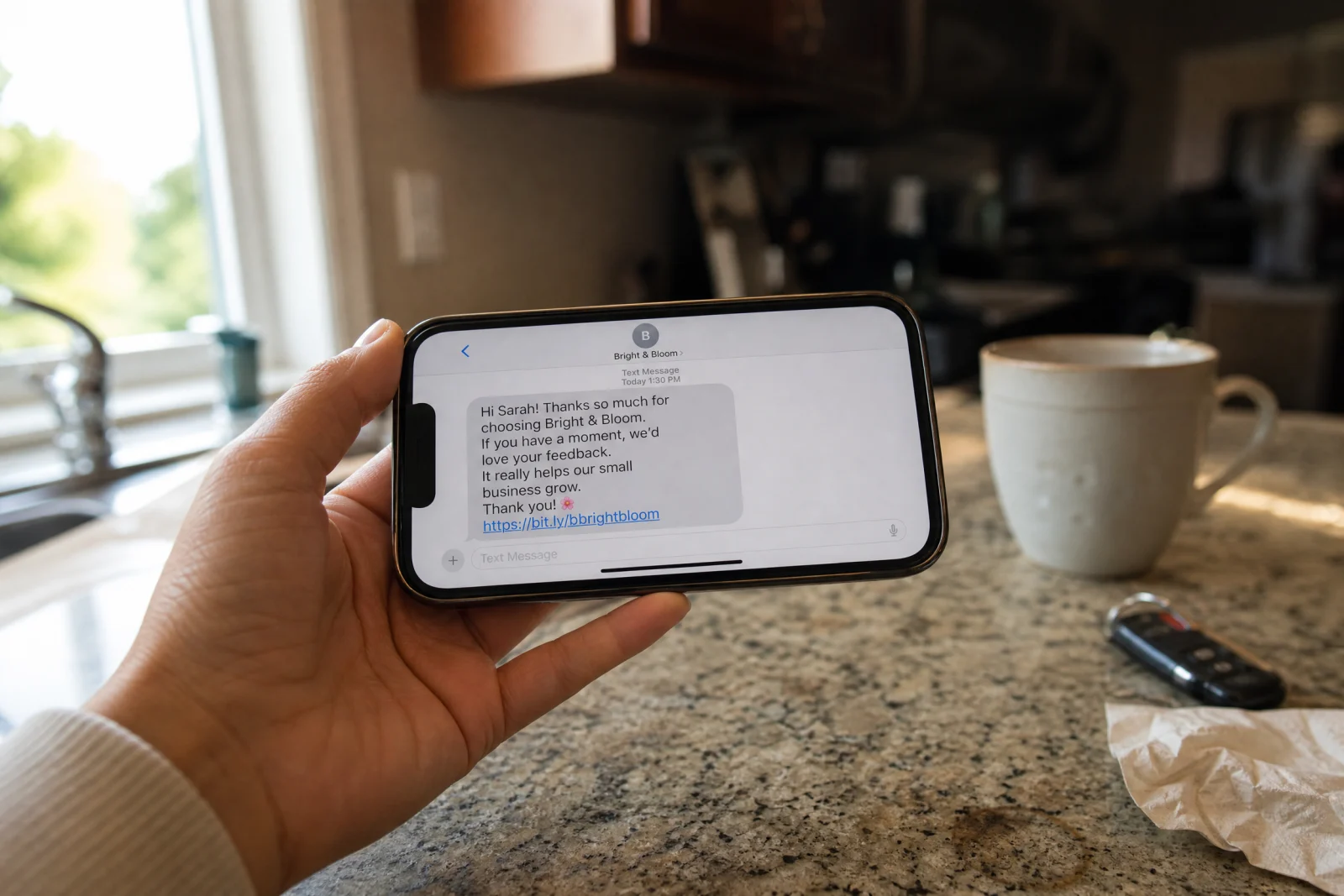
The moment that works is thirty to sixty minutes after you leave.
A plumber finishes a water heater install, cleans up, shakes hands, and drives away. The customer walks back inside, checks that the hot water is running, and feels relieved that the problem is solved. That is the moment. They are still thinking about the experience. They are still grateful. They have not moved on to something else yet. That is when the text message lands: “Hi Sarah, thanks for choosing us today. Mike wrapped up your water heater install. If everything went well, would you share an honest Google review? Here is the link.” The customer is standing in their kitchen, phone already in hand, and the ask feels natural because the job is still fresh.
We call it the driveway text, and it is the highest-converting single tactic we have seen for service businesses. The timing is everything. Two hours later, the moment is gone. The next day, you are competing with every other thing demanding their attention. But thirty minutes after you leave, they are still in the experience, and a quick text feels like a natural follow-up instead of an interruption.
Simple Steps for How to Get More Google Reviews Without Sounding Like Robots
The first time we helped a contractor set up review requests, we wrote a script that sounded like a customer service survey. It was polite, professional, and nobody used it because it felt stiff and fake. The techs hated reading it, and the customers could tell it was scripted. We tried QR codes printed on business cards, which sat in wallets and never got scanned. We tried email templates with corporate-sounding language about “sharing your experience with our team,” which got ignored.
What finally worked was letting the ask sound like a real person talking.
Instead of “We would appreciate it if you could take a moment to provide feedback on our service,” one HVAC tech started saying, “Hey, if this went well today, would you mind leaving us a Google review? It really helps us out.” That is it. No script, no formality, a straightforward ask that sounds like something you would say to a neighbor. The conversion rate went from almost nothing to about one review for every three asks, which is exactly what we needed to start building momentum.
The phrasing matters because it gives the customer an out without making them feel guilty. “If this went well” acknowledges that maybe it did not go perfectly, and that is fine. “Would you mind” is a question, not a demand. “It really helps us out” is honest about why you are asking, and most people are happy to help a local business if you tell them what you need. The customers who had a bad experience will say no or ignore the request, and that is better than pressuring someone into a fake five-star review that violates Google’s content policies and puts your profile at risk.
Building a Follow-Up System That Doesn’t Feel Like Harassment
The driveway text gets you most of your reviews, but not everyone responds the first time. Some people are busy. Some people forget. Some people need a nudge. The trick is knowing when to follow up and when to stop, especially when you are learning how to get more Google reviews consistently without annoying customers.
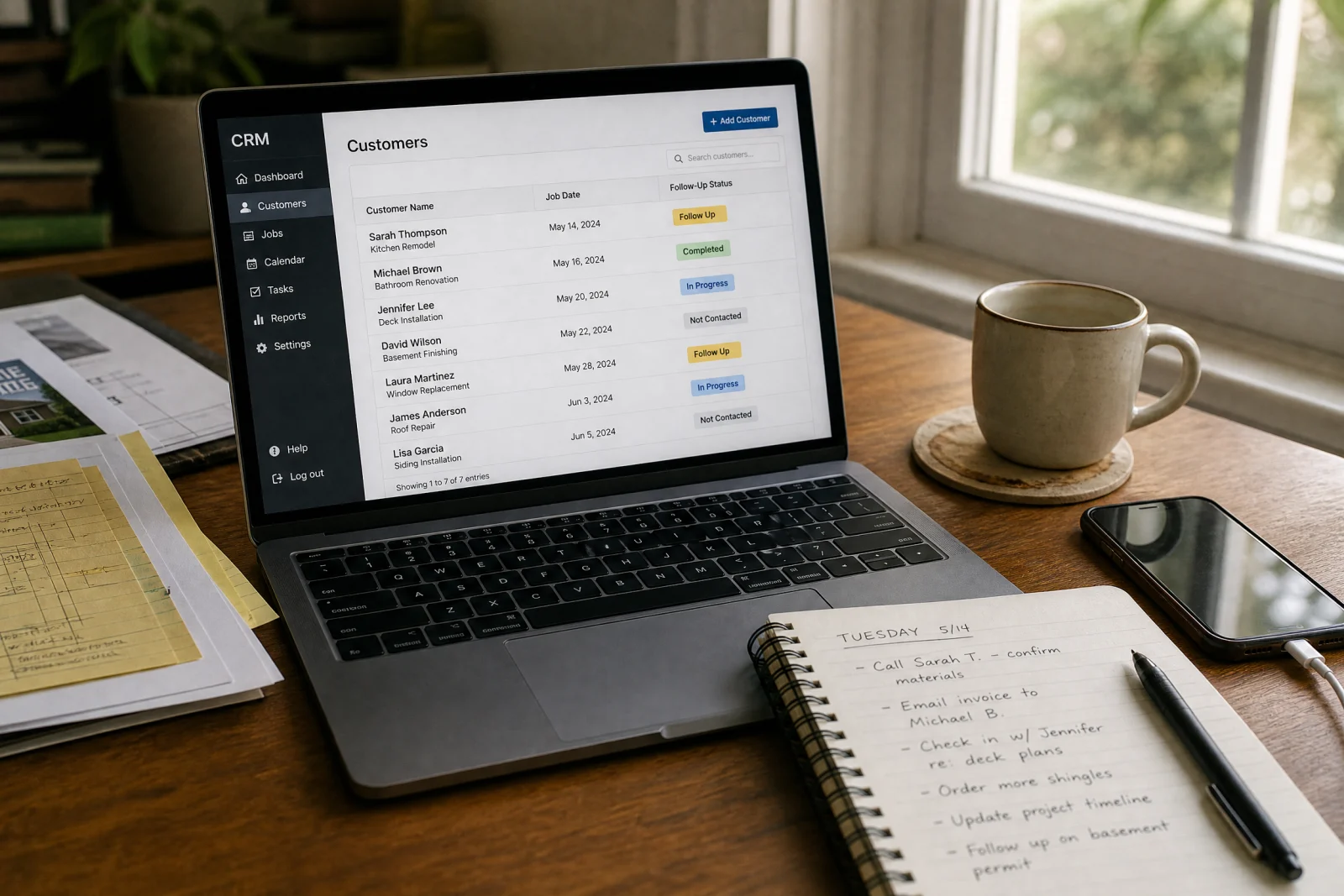
Here is what we do. The first text goes out thirty to sixty minutes after the job is done, with a direct link to the Google review page. If the customer does not respond within three days, we send a second text that is shorter and lighter: “Hi Sarah, following up on the review request from earlier this week. No pressure, but if you have a minute, we would really appreciate it.” That second message usually catches the people who meant to leave a review but forgot. If they still do not respond, we wait until day seven and send one final text: “Last time reaching out about this—if you are happy to leave a review, here is the link. If not, no worries at all.” Then we stop.
Three touches is the limit. Any more than that and you cross the line from helpful reminder to annoying pest, and the last thing you want is to irritate a customer who was happy with your work. The goal is steady growth, not desperation. Google values consistency over time more than it values spikes of activity, so getting one or two reviews per week is better than getting ten in one week and then nothing for a month.
The other part of the system is making the ask easy. Do not tell customers to “search for us on Google and leave a review.” That is three steps, and most people will not bother. Send them a direct link that opens the review page in one tap. If you are asking in person, a QR code works as long as you explain what it does: “This takes you straight to our Google page so you can leave a review right now if you want.” The easier you make it, the more people will follow through. If you are not sure whether your follow-up system is working or where leads are slipping through, our missed-lead system review walks through the same timing and conversion checks we use with service businesses. We also help service businesses set up complete local SEO and lead capture systems that turn your Google presence into a reliable source of new customers.
What Actually Happens When a Review Tanks Your Rating
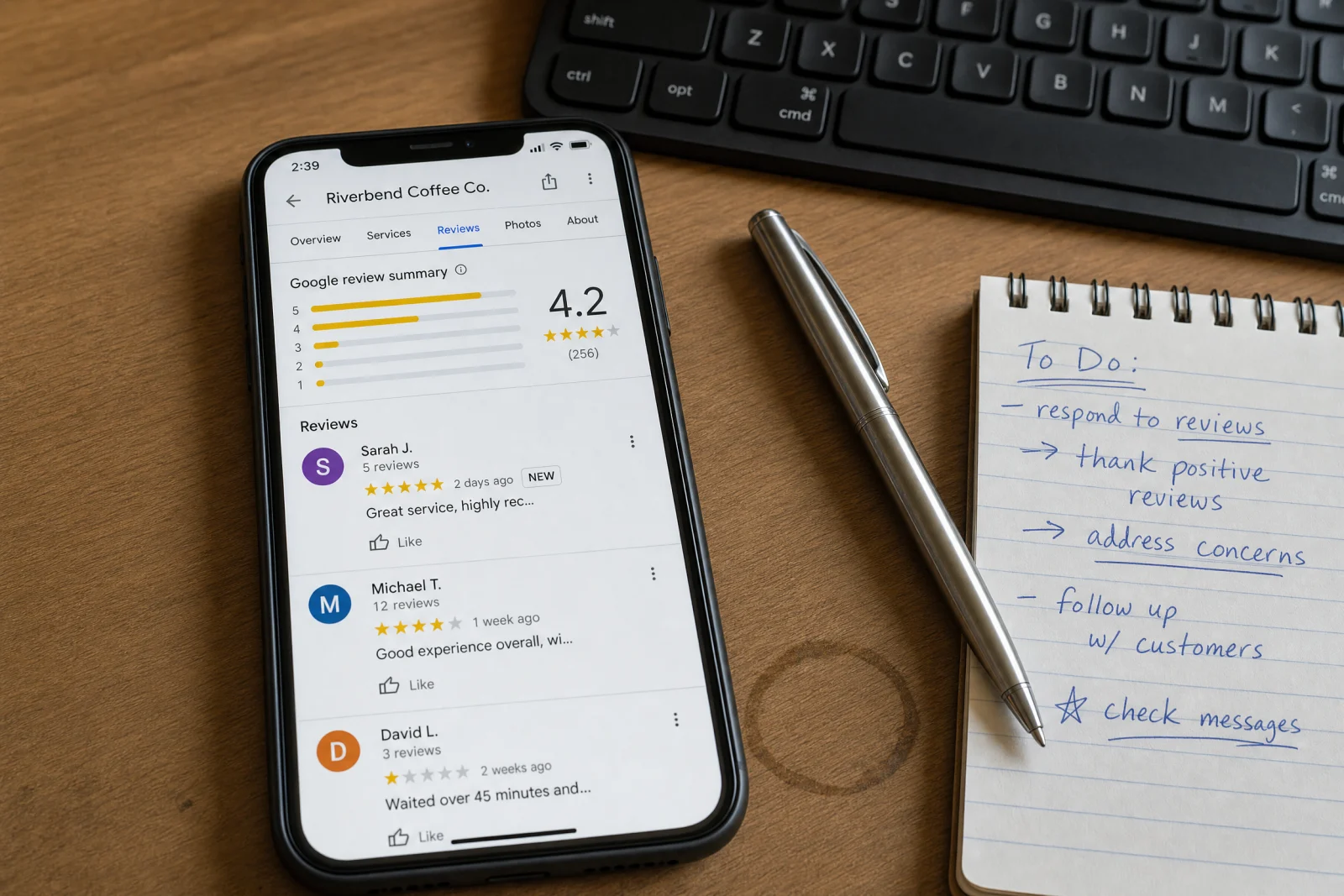
An electrician we work with got a one-star review last fall from a customer who said the tech showed up late and did not clean up after himself. The review was public, it was honest, and it dropped his rating from 4.7 to 4.5 overnight. He called us in a panic, convinced it would ruin his business.
It did not.
We helped him write a response that acknowledged the problem without making excuses: “We are sorry we missed the mark on this one. Being late is not acceptable, and neither is leaving a mess. We have talked to our team about what happened, and we would like the chance to make this right. Please reach out to us directly so we can fix this.” The customer never updated the review, but three other people left reviews the next week specifically mentioning how professional and responsive the company was. The one-star review is still there, but it is buried under newer positive reviews, and the rating climbed back to 4.7 within a month.
Responding well to bad reviews builds more trust than having all five-star reviews, because it shows you care about fixing problems instead of hiding from them. The response is not for the person who left the review. It is for the fifty other people who will read it while deciding whether to call you. Some bad reviews are worth ignoring entirely, though. If someone leaves a rant full of personal attacks or obvious lies, responding gives it more attention. Let it sit, keep getting new reviews, and it will fade into the background.
Why Google Keeps Removing Your Reviews (And What You Can Do About It)
Google ramped up automated review moderation in 2026, and it has been a mess. Reviews that used to go live immediately now sit in limbo for days or weeks while Google’s AI checks them for policy violations. Reviews that have been on your profile for years are suddenly disappearing without explanation. A roofing company we worked with lost nine reviews in one week, all of them real customers, all of them removed by Google’s automated filter.
The problem is that Google is cracking down on fake reviews, which is good, but the AI is also flagging real reviews that happen to match patterns it thinks look suspicious. If five customers all leave reviews in the same week using similar phrasing, Google assumes you are using a template or incentivizing reviews, even if you are not. If a customer leaves a review from a new Google account with no profile picture and no other activity, Google flags it as potentially fake. If someone leaves a glowing five-star review with no text, Google might remove it because it looks like a favor from a friend.
You cannot control what Google’s AI decides to filter, but you can reduce the risk by making sure your review requests do not sound templated. Do not send every customer the exact same message with the exact same wording. Change the phrasing slightly. Mention the specific job they hired you for. Make it clear you are asking for an honest review, not a five-star review. The Federal Trade Commission has made it very clear that incentivizing reviews with discounts, gifts, or anything of value is illegal, and Google’s policies say the same thing. Asking employees to leave reviews is considered fake engagement and will get your profile suspended if Google catches it.
The other thing to know is that Google is dealing with a massive API bug right now that is causing review count discrepancies across profiles. The bug started in late 2025 when Google cracked down on unauthorized data scraping companies, and it accidentally broke parts of the official API that businesses use to track reviews. Google’s engineering team has said they do not expect a fix anytime soon, so if your review count looks wrong or reviews are not showing up where they should, it might not be your fault.
The One Thing That Matters More Than Your Star Rating
A cleaning company we worked with had forty-three reviews and a 4.9-star average. A competitor down the street had ninety-six reviews and a 4.6-star average. The competitor got more calls, even though their rating was lower. The difference was volume.
Customers trust businesses that have a lot of reviews more than businesses with a perfect rating and only a handful of feedback. A 4.6-star average with a hundred reviews tells people that you have been around long enough to build a track record, and that most customers are happy even if a few were not. A 4.9-star average with twenty reviews makes people wonder if the reviews are real, or if you started asking recently, or if you are filtering out the bad ones.
Google’s algorithms work the same way. Review volume is one of the strongest signals for local pack and map placement, according to Google’s own guidance. More reviews means more credibility, more keyword mentions in the review text, and more proof that your business is active and engaged with customers. A business with five hundred reviews can survive a bad week. A business with twenty cannot.
That is why consistency matters more than perfection. Getting two reviews every week for a year is better than getting ten reviews in January and then nothing until June. The businesses that rank well in 2026 are the ones that built a system and stuck with it, not the ones that asked for reviews once and gave up when it felt awkward.
Your First Move This Week
Pull up the list of customers you worked with in the last two weeks. Pick three of them who you know were happy with the job. Text them today with a simple ask: “Hi [Name], thanks again for choosing us for [specific job]. If everything went well, would you mind leaving us a Google review? Here is the link.” That is it. No script, no formality, a straightforward request that gives them permission to help you out. This single action is the foundation of how to get more Google reviews that actually move your ranking and bring in new customers every week.